
How Jobrov matches people and jobs
No magic and no secret score. Here is what happens, step by step.
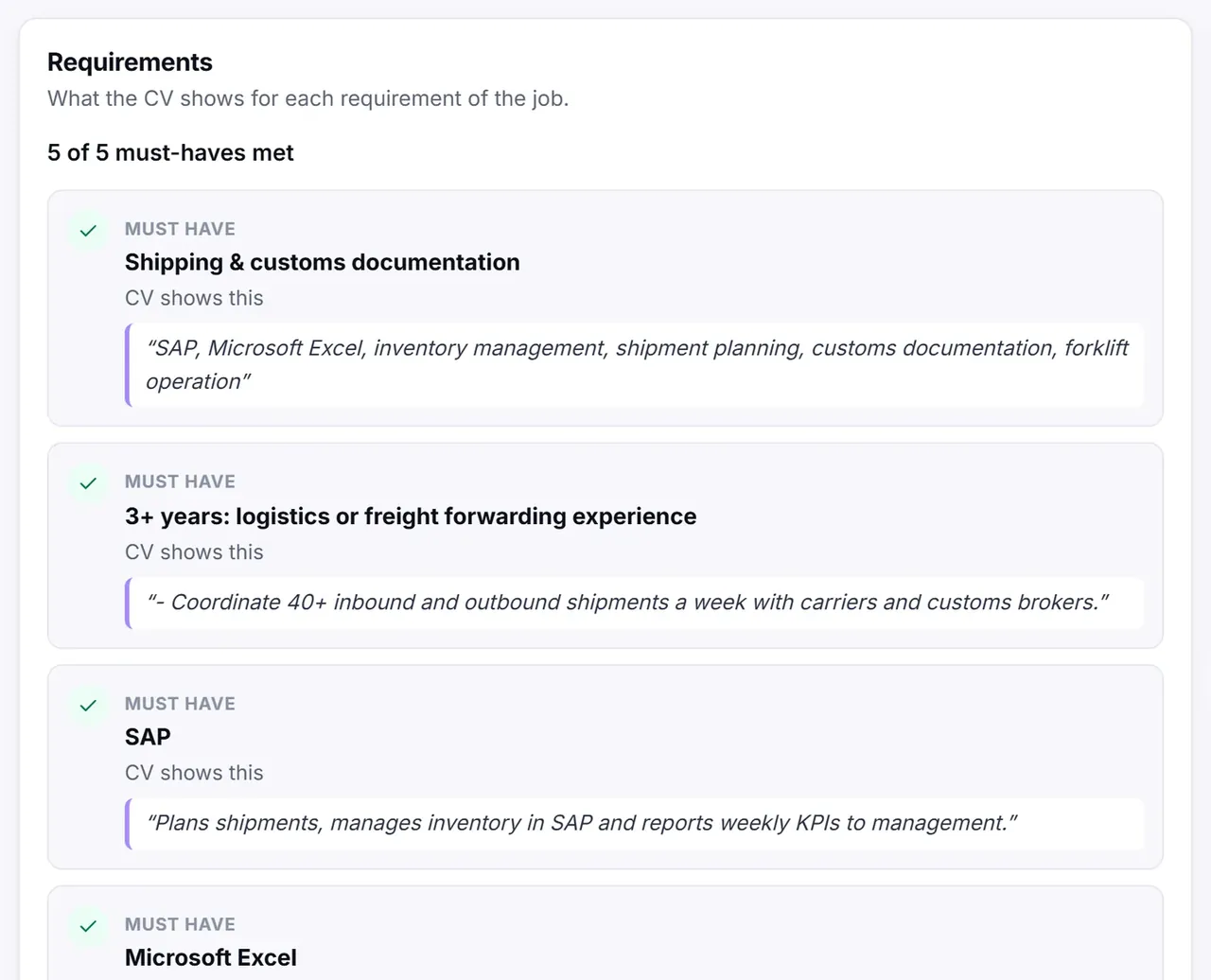
1. We read the job
Jobrov turns the job description into a list of requirements: skills, years of experience, location, languages, licences and salary range. Each one is marked as a must-have or a nice-to-have. The employer checks the list before the job goes live.
2. We read the CV
Jobrov reads the work history, skills, qualifications and languages in the CV. Experience is counted from the dates on the CV, and overlapping jobs are not counted twice.
3. We compare, one requirement at a time
For each requirement, Jobrov looks for proof in the CV. It is either shown, with the exact line quoted, not shown, or unclear.
4. We explain the result
Job seekers see what they meet and what is missing. Employers see the same evidence next to each applicant, so they can check it in seconds.
5. People decide
Jobrov ranks and explains. The employer makes every decision, and nobody is rejected by the software alone.
What a match never looks at
Name, photo, age, gender, religion, nationality and marital status play no part in a ranking. Employers can't ask Jobrov to filter on them either.
- Name and photo
- Age
- Gender
- Religion
- Nationality
- Marital status
When a CV doesn't say
If a CV doesn't mention something, the match shows “not shown”. It doesn't guess, and it doesn't assume the answer is no. Job seekers can add it to their CV and upload again.
Limits we are open about
- AI can misread a CV, especially a scanned image. That is why every reason links to the line it came from.
- A CV made from a document (Word or an exported PDF) reads best.
- A ranking is a starting point for a person to review, never a final answer.
Ready when you are
Hiring or job hunting, it takes a couple of minutes to start.